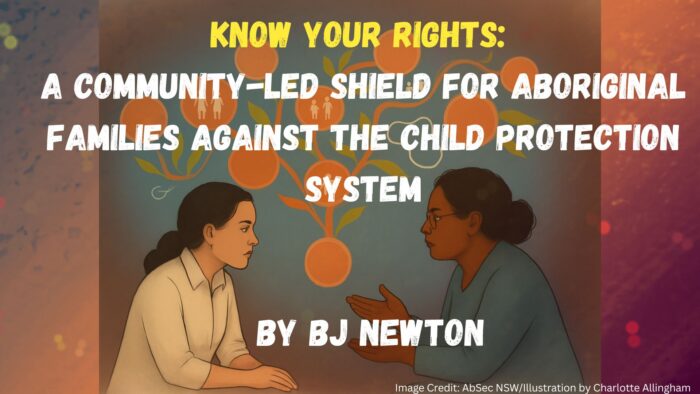
Aboriginal children are removed from their families at unprecedented rates and rarely go home. This is not accidental, but by design. NSW Peak Body AbSec, through Aboriginal-led and community-based UNSW research, have launched the Know Your Rights website so that families can protect themselves against the system.
Readers please be advised that this article contains mention of instances of children being taken from their families.
The child ‘protection’ crisis
Every year, more Aboriginal children are removed from their families and communities by Australia’s child protection systems. In NSW, the number of Aboriginal children entering out-of-home care (OOHC) rose by 25% from the previous year. Across Australia, there are close to 20,000 Aboriginal children living in OOHC, with thousands more on guardianship orders.
Nationally, the restoration rates are dismal, with only about 15% of children being reunified with family. In NSW, restoration rates have declined by more than 40% over the last decade. Too often, young people ‘age out’ of care, abandoned by the system and forced into unstable housing, homelessness, and poverty.
These are not just figures- these statistics represent the thousands of children displaced from their home with loving family who desperately want them back.
Child protection systems are failing our children, families and communities. This truth is not only highlighted in the statistics, but through the dozens of reports, inquiries, and reviews that have exposed this fact for decades. However, this failure is by design, and for the benefit of the colonial agenda.
Aboriginal leaders have been advocating to governments for decades to implement Aboriginal-led solutions to the overrepresentation of Aboriginal children in OOHC. Governments have performed their commitment to addressing this problem, most notably through the Closing the Gap (CTG) Target 12: To reduce the over representation of Aboriginal and Torres Strait Islander children in out-of-home care by 45% by 2031. However, this commitment is just that- a performance. There is no genuine action by governments across Australia to do what needs to be done to meet this target, as was reiterated earlier this month through the latest CTG report which concluded that this target is not on track.
With each new report and wave of policy reform governments promise to do better, to turn the tide on Aboriginal overrepresentation. These are empty promises.
Aboriginal children continue to be ripped away from their families, sentenced to a life of being trafficked around OOHC placements usually in non-Aboriginal foster homes, while their parents and family become trapped in an up-to eighteen-year battle to even see their children regularly, let alone bring them home.
It is in this context that Know Your Rights has been created. This is not merely a resource; it is a necessary shield. A form of community self-determination and an act of resistance. It comes directly from Aboriginal families who wanted future families to have what they did not: knowledge, power, and a fighting chance against the child protection system.
Why Aboriginal families need Know Your Rights
Conditions for Aboriginal children and families will not improve by relying on the system to reform the issues driving overrepresentation. Not only are governments failing to support Aboriginal families to decrease the rates of children in OOHC, but they are also actively sabotaging it by continuing to remove children and refusing to send them home.
This is supported by the tools, assessments, and policies guiding child protection practice. For instance, Structured Decision Making (SDM) are scoring-based assessment tools imported from the United States used to support child protection investigators to determine a child’s level of risk in response to an allegation of abuse or neglect. They are also used to determine the realistic possibility of restoration for parents who want their children home. SDM has been proven to score Aboriginal children as a higher risk, and QLD and NSW have recognised these tools as racist, recently responding by stopping their use.
However, the tools are not the only problem. With the suspension of SDM scoring, caseworkers are left to use their ‘professional judgement’ to determine a child’s level of risk, using SDM as a guide. Child protection caseworkers are products of a colonial system, indoctrinated in the carceral logics and systemic biases that fundamentally perpetuate racism through ritualistic processes, procedures, and legislation.
A clear example of this is in the NSW legislation when parents seek restoration of their child. Parents must meet many (often unreasonable and unachievable) goals, developed by the caseworker to address any safety concerns the department has about the parent, even if this has nothing to do with the reason the child was removed, or there is no evidence that this was a problem for the family.
Families involved in our Aboriginal-led community-based Bring Them Home, Keep Them Home research reported frequent incidents of systems abuse- child protection workers mistreating and intimidating them, raising their voices and standing over parents, using threats of police for compliance at hospitals after childbirth, using coercive control to consent to removals, being deliberately cruel, withholding information about their intent to remove children and setting families up to fail in to achieve restoration.
One mother, Shellie, described being surrounded caseworkers who stood over her at her kitchen table:
“There was five of them and…it was only me by myself, and they would stand as well, they wouldn’t sit at my table. So, I’m sitting and they’re talking over me”
Jayda told us:
“They ripped my family apart knowing the next day was my daughter’s birthday… My son said he has nightmares every year leading up to it.”
Caseworkers are known to lie or operate with a lack of transparency about whether they intend on taking children from their parents, so families are blindsided and unprepared. Tee reported:
“I had multiple meetings with these people throughout my pregnancy. They were just pushing. It was like they just wanted me to break or something. But they told me the whole pregnancy I wasn’t losing my kids. There’s no plans of removal”.
After the birth of her son, Tee was coerced into signing a ‘voluntary’ agreement to temporarily remove her children. If she didn’t, the police would be called.
Chloe recounted the endless tasks she had to complete to get her children home, illustrating how the system is geared toward keeping children in OOHC:
“I’ve been clean for over 12 years now. I tried so hard for so long to get the kids back and I kept on getting knocked back… I thought that if I done all these parenting programs, I addressed my mental health issues and I was drug free, I thought that if I done all of this and went back to court that I would get my kids back, and that wasn’t the case at all”
Chloe was a young Aboriginal mum whose non-Aboriginal partner used violence against her. The children were removed in this context, and DCJ placed them with her partner’s mother, where her now ex-partner also resided. The children were weaponised against Chloe to further perpetrate violence, as her ex-partner and his mother refused Chloe access to her children. Chloe feared for her children’s safety and every time she raised her concerns with DCJ, she was dismissed as lying to cause trouble. It was a decade later, after her son found the courage to run away from his abusive father, that DCJ recognised that Chloe’s concerns for her children were warranted.
These stories are devastating- and happening today. These are not experiences of the past, and they expose the unjust realities for many Aboriginal families. But all hope is not lost. Through Bring Them Home, Keep Them Home, we have uncovered how families challenged unethical casework, biased assessments, the misrepresenting of family narratives, and the strategies they use to keep their family connected and fight to get their children home. That is the foundations for Know Your Rights.
What Know Your Rights offers Aboriginal families and advocates
After several years of Aboriginal-led research, community collaborations, and rigorous analysis, we are launching a critical advocacy resource that has been needed for generations: an accessible, plain‑language, community‑driven website, Know Your Rights: Aboriginal Families Navigating NSW Child Protection Systems & Finding Supports.
When children are taken by child protection, parents feel shame, guilt, shock, overwhelming grief, and confusion about what to do and where to go for help. KYR is much more than a website. It is a guiding light for families during their darkest time. It is a protective mechanism and an act of resistance. Combining a suite of interactive features, the website offers for Aboriginal families and those supporting them:
Guided videos that walk-through child protection processes, legislation and advice
Video animations and stories recounting the experiences of Aboriginal families going through the system
Journey maps and interactive flowcharts to understand all steps of child protection interventions, removal, restoration, and court processes
Workbooks for parents to use to build their own evidence to support their case
Printable quick reference information guides for easy access
Knowledge about how the system operates to blame parents, punish poverty, and enact violence against families in the name of ‘protection’
Information and resources for finding the right advocacy and legal advice
Grounded in the experiences of Aboriginal families who have walked this path, Know Your Rights uses research, evidence, and families’ experiences to debunk myths surrounding parent blame and offers parents the validation and moral solidarity needed to give them the strength to keep going. It offers the knowledge and education needed to shift the overwhelming power imbalance between Aboriginal families and the state when children are removed.
Our aim for this website is to simultaneously wrap parents a warm virtual hug, so they know they are not alone, while also arming them with the strength and the tools to fight to keep their family together.
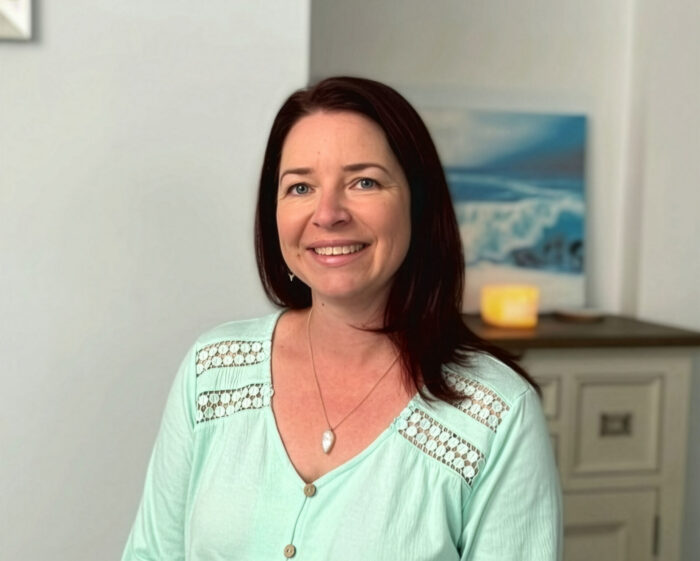
Scientia Associate Professor BJ Newton is a proud Wiradjuri woman and leading expert in Australian child protection research and policy with a focus on restoring Aboriginal and Torres Strait Islander children from out-of-home care. Her research program, Bring Them Home, Keep Them Home, is the first international study examining restoration rates, outcomes, and experiences for Aboriginal children in out-of-home care. In partnership with Aboriginal organisations, her research drives sector-wide impact through truth-telling, generating new evidence, community-led initiatives, and advocacy. BJ’s most recent funding through a National Health and Medical Research Council Investigator Grant will build on this work (2026-2030), titled Understanding systems abuse and Aboriginal resistance in child protection contexts.
Readers please be advised that this article mentions a person who has passed away. 3August 2026 “Felipe’s life mattered. His death mattered. What we learn…
This Aboriginal and Torres Strait Islander Children’s Day, we have an opportunity to reflect on something remarkable. Across Victoria, our Aboriginal and Torres Strait Islander…
A reflection on Sorry Day and Reconciliation Week 2026
It’s Sorry Day and Reconciliation week and I’m reminded again that language matters. White people tell me this constantly. Use the right language. Tone it…
Subscribe
I would like to receive the IndigenousX monthly newsletter