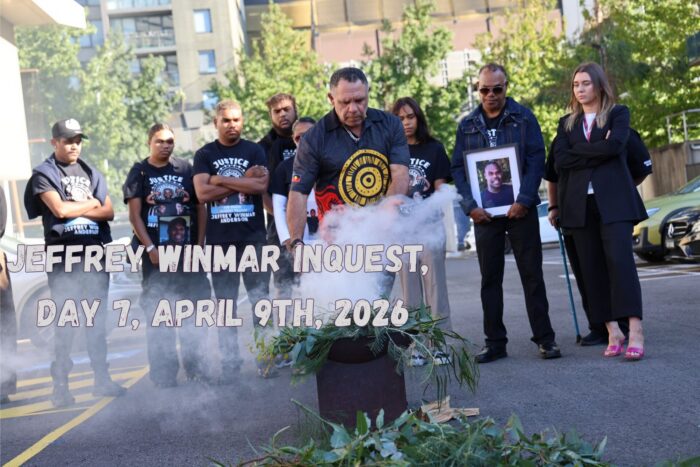
The inquest into the death in custody of Noongar man Jeffrey Winmar commenced on 30th March, 2026, and will continue until 10th April, 2026. These daily reports from Dhadjowa aim to ensure that the community can be truthfully informed of what takes place inside institutional walls.
Disclaimer: Aboriginal and Torres Strait Islander readers please be advised this article mentions the name of an Aboriginal person who has died in custody. This article also mentions acts of violence. Accounts and names have been published with permission given to the author from the family.
Day 7 – 9 April
The coronal inquest into the death of 28-year-old Noongar man Jeffrey Winmar resumed for its seventh day of session this morning.
Today we heard medical evidence from the doctors involved in Jeffrey’s care and two expert medical panels.
Prior to calling the first Witness, Mr Nathwani, Counsel acting on behalf of Jeffrey’s family addresses the Coroner, “some of the family may not be present today due to the nature of the evidence.”
Today’s summary includes details from the autopsy findings after Jeffrey’s passing. This information is distressing and we encourage people to take care while reading this summary.
***
The first witness called to give evidence is Dr Sayed Hassen. Dr Hassen is a surgeon, specialising in issues concerning the liver. He performed two surgeries on Jeffrey after he was taken to Box Hill Hospital via ambulance on 9 November.
While Dr Hassen did not have direct contact with Jeffrey following his immediate presentation to Box Hill Hospital, according to Dr Hasseen, Jeffrey was “critically unwell with a poor prognosis” upon his arrival at Box Hill Hospital.
Dr Hasseen is questioned about the handover Box Hill Hospital received from Ambulance Victoria and Victoria Police.
Ms Wong:It appears that the treating team had not been told that Jeffrey had jumped from a height of 3 meters?
Dr Hasseen: No, I don’t recall reading that initially, but we did know there was a pursuit of some kind.
When asked if this information would have earlier drawn the hospital’s attention to the possibility of internal injuries, Dr Haseen gives evidence that he does not believe that it would have materially changed Jeffrey’s treatment plan.
We learn that Jeffrey was transferred to the Intensive Care Unit at around 9:00pm, at which point Jeffrey was intubated and not breathing on his own. When asked about his condition at this point in time, Dr Hasseen expresses: “[Jeffrey] was more unwell than most patients in intensive care..his state was critical in more ways than one. “
After Jeffrey was transferred to the ICU a fast scan was done by an ICU consultant who noted free fluid around Jeffrey’s internal organs, which they believed to be blood.
We learn that two to three litres of blood were found in Jeffrey’s abdomen during the first surgery conducted by Dr Hassen.
Counsel Assisting puts it to Dr Hasseen that one of the concerns of Jeffrey’s family is that he was in hospital for a period of hours and that the internal bleeding that Jeffery experienced was missed by medical staff.
When asked to respond to this concern, Dr Hasseen states there were many things contributing to Jeffrey’s medical condition at this point in time, including multiple cardiac arrests.
When asked if the injury that Jeffrey sustained to his liver likely contributed to the cardiac arrest that Jeffrey experienced, Dr Hasseen gives evidence that it is unlikely, going on to express “he wasn’t behaving like someone who had a significant internal bleed at that time”.
Dr Hasseen goes on to give evidence that the pattern of injuries – including the injuries to his livers and ribs – were compatible with injuries that may have been sustained from CPR.
It is later put to Dr Hasseen by Mr Nathwani, Counsel acting on behalf of Jeffrey’s father, that Jeffrey complained of sore ribs in the initial moments after he first lost consciousness under the tree.
Mr Nathwani: Would it be relevant for medical practitioners to have known that he complained of sore ribs before CPR?
Dr Hasseen: Yes it would be, it suggests something else happened at this point.
Mr Nathwani: Indicative of an issue isn’t it?
Dr Hasseen: Yes.
Mr Nathwani: Would it be relevant for medical practitioners to have known that Jeffrey complained of sore ribs before CPR?
Dr Hasseen: Yes it would be, it suggests something else happened at this point.
Dr Hassen is asked about the contact he and his colleagues had with Jeffrey’s family about his medical condition.
Mr Nathwani: Were you aware that either you or one of your colleagues specifically asked the family whether Jeffrey had been in a fight?
Dr Hasseen: No.
Ms Wong: Jeffrey’s mother Ursulla, has a distinct recollection that you spoke to her after the first laparotomy, and that you asked her whether Jeffrey had been in a fight. Is it your evidence that you don’t remember saying that?
Dr Hasseen: It was about two and a half years ago.Look, it’s possible that I have spoken to her, but I can’t recall whether there was something that prompted me to ask the question. The pattern of bruising might have prompted me to ask a question as to why there was bruising… I don’t recall that that conversation, but it might have happened
***
After the morning tea break, a four-person expert panel of emergency and intensive care physicians are called to give evidence. This panel consists of Associate Professor Neil Collier (General Surgeon), Associate Professor Anthony Cross (Emergency Medicine and Intensive Care Specialist, Director of Intensive Care at The Northern Hospital), Professor Mark Fitzgerald (Emergency Physician and Director of Trauma at Alfred Hospital, Director National Trauma Research Institute), and Associate Professor Stephen Warrillow (Intensive Care Specialist at Austin Health, PhD in critical care haematology).
We learn that Jeffrey experienced both circulatory and cardiac arrest, and that the paramedics documented Jeffrey as asystolic. When asked to differentiate between the severity of these medical arrests, Associate Professor Stephen Warrillow explains:
“The literature shows that recovery from [asystolic arrest] almost never happens, so less than a couple of percent of people will leave hospital, and even a smaller fraction will have a good brain function afterwards…Out of hospital, it’s almost always fatal. It’s very uncommon to survive.”
There is consensus amongst the panel that by the time that the ambulance arrived Jeffrey had a low chance of survival.
Associate Professor Stephen Warrillow: “In 20 years of intensive care specialist practice I have never seen someone who had asystole and 20 minutes of CPR survive.”
The panel is asked to share their views on what they believed caused Jeffrey to collapse. In Professor Warrilow’s opinion, there are two probable explanations, either intra-abdominal bleeding from a liver injury or complications from methamphetamine toxicity in the setting of high level physical exertion.
He goes on to express:
“Someone who’s very frightened and vigorously exercising, an adult who is being pursued or is very fearful…One would anticipate that Jeffrey’s level of adrenaline would have been very, very high in the setting of also having very likely high levels of methamphetamine in his system. And I’ve certainly had cases where a person in that situation can have a sudden cardiac death, without invoking other potential contributing factors, albeit, I acknowledge those other contributing factors may have played a role in Jeffrey’s [cardiac and circulatory] arrest.”
***
After the afternoon break, a second expert panel focused on forensic pathology is called to give evidence. This panel is comprised of three experts: Dr Hans de Boer, the forensic pathologist at the Victorian Institute of Forensic Medicine who conducted the medical examination of Jeffrey’s body following his death; Professor Dimitri Gerostamoulos, Head of Forensic Science at the Victorian Institute of Forensic Medicine; and Professor Johan Duflou, a consultant forensic pathologist.
The panel is asked for their expert opinion on when Jeffrey likely sustained the injuries to his liver. The panel is in agreement that these injuries were likely sustained on 9 November.
Dr Boer explains:
“..I can’t say whether the injuries were sustained at the time of CPR, five minutes before that or an hour before that, but definitely there was no evidence of injury of days preceding the cardiac arrest.”
When asked for their opinion of the cause of death, the panel agrees that Jeffrey most likely experienced a cardiac arrest as a result of methamphetamines, coupled together with stressful events and physical exertion.
***
Tomorrow, Friday April 10, is the final day of the coronial inquest into the death of 28 year old Noongar man Jeffrey Winmar.
We call on supporters to join us at the Victorian Coroner’s Court (65 Kavanagh St, Southbank) in support of Jeffrey’s family at 10am tomorrow..
Having heard only from police and medical witnesses up until this point, tomorrow Jeffrey’s family will share their coronial impact statements with the Coroner.
It is crucial that Jeffrey’s family feel the presence of people willing to hear and witness their pain and grief.
We would like to take this opportunity to send love to all the families who continue to fight for justice. This fight is not yours alone but you shoulder the weight of it as you grieve while staunchly fighting for justice. We see you, we hear you, we are with you and we love you.
Hear the families’ calls for justice, 30 years and 474 black deaths in custody since the Royal Commission
If we collectively support the families’ calls and call on governments to act, we can end this injustice once and for all. We cannot, and must not, wait another generation for change.