
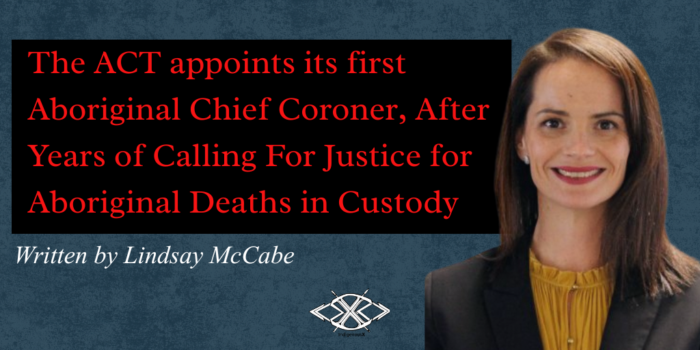
The ACT appoints its first Aboriginal Chief Coroner, After Years of Calling For Justice for Aboriginal Deaths in Custody
This article includes the names of Aboriginal People who have died, and mentions instances of racism.
History has been made with the announcement of the appointment of Justice Louise Taylor as Chief Magistrate of the ACT – a role that also makes her the Chief Coroner. Justice Taylor is a proud Kamilaroi woman with a long record of leadership in law and justice. She was appointed as the first Aboriginal Resident Judge in the ACT Supreme Court in 2023, and has worked across both ACT and Commonwealth courts. Justice Taylor has also served on the prestigious Law Council of Australia’s Indigenous Legal Issues Committee, and is patron of Sisters in Spirit Aboriginal Corporation. In 2019, she was named ANU Indigenous Alumna of the Year, for her contributions to Aboriginal and Torres Strait Islander rights, and access to justice for women in the ACT community.
Justice Taylor’s appointment as Chief Magistrate also means she is now the Chief Coroner of the ACT, making her the first known Aboriginal coroner in Australia.
In the ACT, magistrates are also coroners, and the Chief Magistrate is also the Chief Coroner. Coronial proceedings are very different to other kinds of law. For example, criminal law is ‘adversarial’, meaning the two sides (the prosecutor and the defence) are opponents trying to prove that their story is the truthful one. Coroners and their investigations, on the other hand, are ‘inquisitorial’. The point of a coronial investigation and inquest is to try to find the ‘truth’ of how a person died – the medical cause of their death, but also the factors that led to the person dying, and whether or not the death could have been prevented.
Coroners investigate deaths that are sudden, suspicious, or unexplained. They also are required to investigate deaths that occur in state custody, such as deaths in custody. As the number of Aboriginal People dying in custody continues to rise, so too does the need for coronial inquests (called ‘hearings’ in the ACT) into those deaths. Too often, the deaths of Aboriginal Peoples are explained away as ‘natural deaths’, and issues such as systemic racism are not always part of the coroner’s investigation.
Having an Aboriginal coroner matters. It means that lived experience of racism, discrimination, and the impacts of colonisation are more likely to be recognised as relevant to how and why Aboriginal people die, particularly in custody. Too often, coroners exclude families’ wishes in making key decisions, as they did in Ms Dhu’s inquest. Many families, like the Hampsons and the Booths, have to fight for the chance to be heard, with coronial investigations only being granted after years of battling. Most recently, the family of Noongar man Jeffrey Winmar highlighted the failure of the coronial inquest to understand systemic issues, such as police behaviours. There are many reasons that coronial inquests have been described as ‘inherently unsafe’ for our people.
As part of their death-prevention focus, coroners can make recommendations at the end of a coronial inquest to try to prevent similar deaths from occurring in the future. If the kinds of issues that we experience as Aboriginal Peoples are understood by coroners, then there is an opportunity to prevent deaths among our people, and especially those that happen in custody.
The inquest into the death of Gunditjmara, Dja Dja Wurrung, Wiradjuri and Yorta Yorta woman Veronica Nelson was one of the first to include systemic racism in its investigation, with recommendations made that resulted in bail reforms to reduce remand for minor offences. While much of these reforms have since been reversed by new bail laws, that the reforms occurred in the first place show the potential of the coronial inquest system to both identify the operation of systemic racism, and to make recommendations to address it.
The issue of systemic racism was not included in the coronial inquest held to investigate the death of Nathan Booth. Because of this, the coroner could not make findings about the systemic racism the family experienced from ACT Police, and no recommendations to prevent this from happening to another family could be made. Again, having an Aboriginal coroner matters. It means that lived experience of racism, discrimination, and the impacts of colonisation are more likely to be recognised as relevant to how and why Aboriginal people die, leading to informed recommendations that may prevent similar deaths from occurring.
While one appointment alone cannot fix a system that has failed Aboriginal People for generations, Justice Taylor’s leadership as Chief Coroner offers a crucial opportunity for change. The ACT is at crisis point, with a Board of Inquiry established in May 2025 to investigate the alarming number of deaths of Aboriginal and Torres Strait Islander People who have died in the Alexander Machonochie Centre, where three First Nations men died within twelve months. Each of those deaths will be the subject of a coronial inquest, processes now overseen by Justice Taylor as Chief Coroner.
To be the first Aboriginal person appointed as Chief Magistrate and Chief Coroner of the ACT is an enormous achievement. Justice Taylor’s appointment reflects both her longstanding commitment to justice and the growing recognition that Aboriginal voices must be present in the institutions that investigate the deaths of Aboriginal People. Coronial courts sit at the intersection of grief, recognition, and prevention. Justice Taylor’s appointment offers an opportunity for these processes to be guided by lived experience, understanding and cultural knowledge. This moment matters for our communities, for families seeking answers, and for a system that must do better. It is a significant step forward, and we congratulate Justice Taylor on this historic appointment.