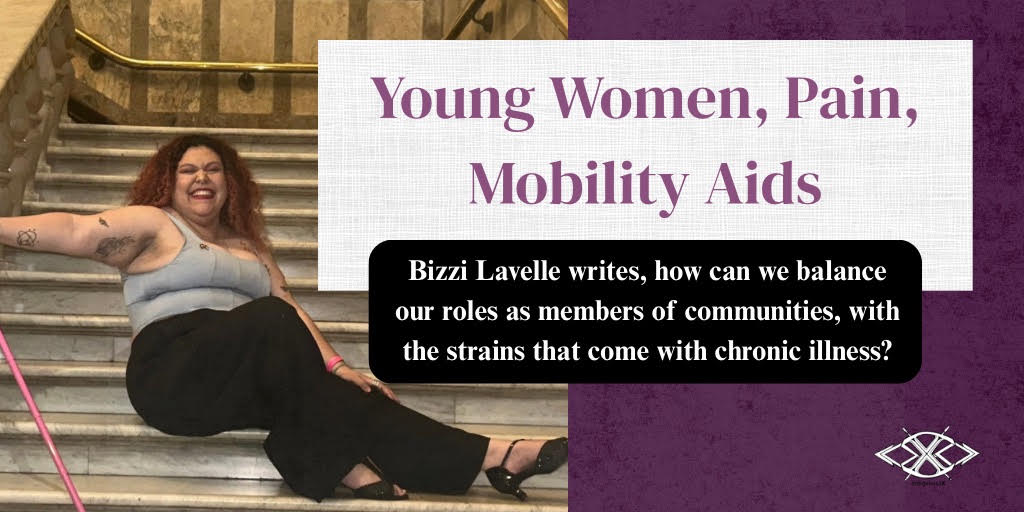
Bizzi Lavelle writes, how can we balance our roles as members of communities, with the strains that come with chronic illness?
To be sick, or have a health condition of any kind is not a moral failing. I know this and I hope that you do too. However, every time I find myself staying in or leaving something early because I’m in pain or I’m fatigued, I can’t help but feel the people around me are disappointed.
People wish they had a friend who could come to their fortnightly event like they said they would. They wish they could book a performer to MC an event without them withdrawing due to spending that week pain ridden in bed. They wish the friend they extended a birthday party invite made it instead of sending through an apologetic message. They wish their friend would be in the room cheering them on at their weekly drag comp or production show.
A common online talking point echoes in my head as I send my latest “I’m sorry” message; you have to inconvenience yourself a little for the sake of your community. You have to be someone’s villager if you want to have a village.
With the weeks or days I spend hidden away, inside, barely leaving the house I often ask myself, do I deserve to be in anyone’s village? Do I deserve my own villagers?
The words to Rina Sawayama’s ‘Bad Friend’ circle my mind as I spend another Saturday night in my pajamas, watching anime in bed: “So don’t ask me where I’ve been, been avoiding everything.”
As I’m lamenting my woes to my notes app and the friends who get it, an article from The Times UK comes across my feed. “Why are young women using walking sticks?” by Katherine Stock. And then another, this time from The Telegraph, “How having a disability became cool” by Poppy Coburn.
The themes of these pieces are misogyny and ableism, with sprinkles of transphobia and ageism.
In both of these pieces, the authors seem to believe that young women in increasing numbers are faking to be disabled for social clout. In the first piece, Stock declares young women using mobility aids and posting about being ill are victims of “social contagion” deems the pain they’re in as “unclear” and therefore “unclear” if these women “really have” disabilities.
Disability and chronic illness comes in many forms
It’s wild to me, that in 2026, anyone would partake in such ableist vitriol. Despite what both authors think, there are a wide range of ways to be disabled. Disability and chronic illness don’t always look like a wheelchair user. Sometimes disabilities and chronic illnesses are invisible. Sometimes they’re dynamic. The only criteria to being disabled is having a condition, injury or alike that impedes you and your ability to do day to day tasks.
Disability is the only minority group a person can become part of at a moment’s notice, and is the only minority group we will all be part of at some point in our lives. As my friend, Protect our NDIS rally organiser and activist Oriela says “You will become disabled. That’s a promise not just a threat”.
That one influencer you follow could one day be surfing and the next using a wheelchair or cane. You aren’t able to discern how much pain someone is in by simply looking at them. If that were the case, women wouldn’t be waiting years for their pain to be believed and diagnosed.
For Aboriginal women, seeking medical care has an extra layer of stress. Racial bias in medicine historically saw beliefs that bla(c)k people, particularly women, have a higher pain tolerance than their white counterparts. This, along with classic medical misogyny has led to Aboriginal women being mistreated, ignored or treated as though they’re only ‘drug seeking’.
In Allanah Hunt’s 2024 piece ‘The Good Patient’, she details her experiences of medical racism as she navigates dealing with endometriosis. Despite Allanah’s attempts to present to hospitals as the best and most polite patient, her pain was still disbelieved and she was still treated as a drug seeker. “Because the truth is, no matter how much I’m ‘the good patient’, I will never escape the racial judgement from healthcare providers” Allanah writes.
Similarly, Colleen Lavelle (my mother) discusses her experience of medical racism in her 2017 piece. “Death by racism: bigotry in the health system is harming Indigenous patients’”.
She notes from her own experiences and other First Nations people whose medical experiences she’s listened to that a common thread is wondering if you’ve been overly sensitive.
Disabled people don’t owe you an explanation
One memory I have from my teens is when I was at the shops with my mum and younger sister. I went out to the car to put some bags in the car and a man questioned me from his car since he saw a teen girl using a disabled parking spot. He grilled me and told me off for using the spot, not once considering or listening as I explained the car had a permit and I was bringing bags to the car so my mother, the owner of the permit, could stay inside and sit for a moment.
I didn’t look how he wanted or expected disability to look, and so I got chewed out. Aside from not listening, he didn’t consider I could’ve been the disabled person.
Through my own medical journey I’ve had some of the experiences both Allanah and Colleen have shared. It took 10 years and two laparoscopies for me to finally have an endometriosis diagnosis. I was discharged with zero pain killers, and consistently told by my doctor growing up that periods are a spectrum and some people have light and short ones and some, like me, have extremely heavy and painful ones.
I’ve had a doctor suggest the solve for my at the time undiagnosed chronic pain was to lose weight. Something a lot of people, women in particular, are told is the main cause for unrelated illness. Such a suggestion is to me, another clear example of medical misogyny. I was in chronic pain and had heavy periods when I was “average” weight, so it stands to reason I would still experience them even as my size fluctuates.
In her piece, Coburn writes that “the country (the UK) is sicker than before” and notes that often, the sick women she stalks on social media usually have more than one diagnosis. It’s confusing and worrying to me that Coburn not only doesn’t understand that concept of comorbidities, but she also doesn’t seem to understand that perhaps after a mass disabling event like the pandemic, that people would be sick after.
In 2023, content creator Sydney Towle was diagnosed with cholangiocarcinoma, an aggressive cancer of the bile duct. Sydney shared her diagnosis with her followers and began including content around living with cancer in her posts. Many watching online found it difficult to believe that Sydney would have cancer. She was so young and was still posting about the things that other people in their 20’s would be posting. As Sydney continued documenting her health, thousands of people accused her of faking cancer, and created subreddits for the sole purpose of picking apart her posts and proving she was faking for clout. In 2026, after Sydney’s cancer worsened, she passed away.
In an interview Sydney stated that “they are so angry that living with cancer can look different than they think it should”.
Which really, is the summary of all of this. There is so little to gain from pretending to be sick. When I use my walking stick or wear my sunflower lanyard I’m not suddenly receiving special treatment or oodles of social capital. It’s actually the opposite, as I wonder if my injuries or illnesses are “enough” to warrant taking a seat.
Sydney, (and any other disbelieved sick woman) deserved to be able to find love, document her holidays, have good days and bad ones, run marathons and surf and go to bed at night with a warm heart and deeper lines on her face from laughter and smiling.
Despite having a body ravaged by illness or pain, sick women deserve to be seen as whole people and not purely as their illnesses.
I have endometriosis, eczema, polymetabolic ovarian syndrome, a wonky knee and two wonky ankles but I also have a love of performing, laughing, protesting, anime and glitter. I deserve to be seen and known for the exciting things but still have my pain believed and acknowledged.
The day I was the first burlesque dancer to ever perform at the Women Deliver international conference was still the same day I lay in bed afterwards in more pain than I could explain.
What disbelievers miss is that often the things we love to do come to our own detriment. That we can’t simply just throw caution to the wind and go for a surf.
If I want to be social, or perform, I have to meticulously plan every detail. Will I have enough energy? Do I have enough pain killers on me, and will I be able to eat something so I can take them? Should I bring my stick just in case or will it be bulky in my bag and go unused if I don’t need it? Will I be able to rest that evening or the next day? What if I don’t pack something but then need it?
Disability and chronic illness look different than the general perception we expect. People like Coburn, Stock and Sydney Towle’s snarkers expect people to do nothing but be ill and speak of being ill. Chronic illness and disability doesn’t have to be frail, old and bed ridden. It can be a 20-30 year old woman in bright colours living a joyous life using a pink walking stick.
These people have no idea what it feels like to be betrayed by a body you grew up in.
To be stuck in a vessel that you know could at one point could do anything you wished it to only to now be exhausted by the smallest things. I wouldn’t wish disability or chronic illness on anyone, but what I do wish on Coburn, Stock and those that think alike is kindness, empathy, common sense and a modicum of comprehension.
Bizzi Lavelle is a Queer Wakka Wakka and Arrente writer and burlesque dancer.
She was awarded 2nd Runner Up at the Australian Burlesque Festival’s “New Follies“ competition, “Out for Australia – 30 Under 30” Rising Star Award, and the First Nations Leadership and Engagement Award from the 62nd Annual Queens Ball Awards 2023.
Her areas of expertise are gender, sexuality, and Bla(c)k feminism.
Readers please be advised that this article mentions a person who has passed away. 3August 2026 “Felipe’s life mattered. His death mattered. What we learn…
This Aboriginal and Torres Strait Islander Children’s Day, we have an opportunity to reflect on something remarkable. Across Victoria, our Aboriginal and Torres Strait Islander…
A reflection on Sorry Day and Reconciliation Week 2026
It’s Sorry Day and Reconciliation week and I’m reminded again that language matters. White people tell me this constantly. Use the right language. Tone it…
Subscribe
I would like to receive the IndigenousX monthly newsletter