
MEDIA STATEMENT : FELIPE ALVAREZ CORONIAL INQUEST
Readers please be advised that this article mentions a person who has passed away.
3August 2026
“Felipe’s life mattered. His death mattered. What we learn from his death matters.”
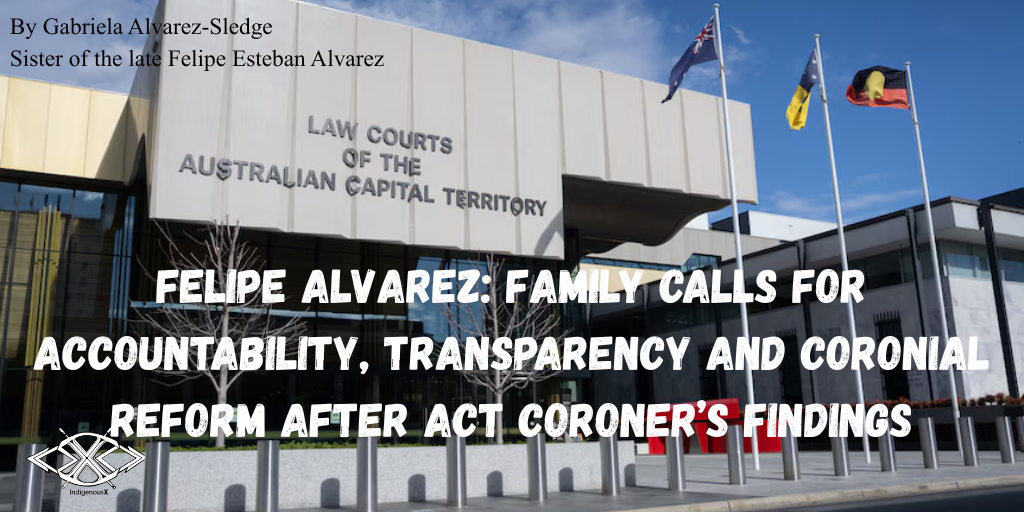
The family of the late Felipe Esteban Alvarez is calling for greater transparency, accountability and reform of the ACT coronial system following the release of the findings into his death.
Felipe died in March 2021 following an overdose at his Canberra residence.
Five years later, his family is still grieving while asking an important question:
What can be changed so that another family does not have to go through what ours has experienced?
Felipe was not simply a coronial file.
He was a brother, son, uncle and deeply loved member of his family.
His life had value.
His family believes his death deserved to be investigated as thoroughly, transparently and independently as possible.
WHAT THE CORONER FOUND
The findings of ACT Coroner Ken Archer identified serious concerns surrounding the circumstances of Felipe’s death.
The Coroner found that Felipe was experiencing a medical emergency and that emergency medical assistance was not sought for a significant period of time.
The Coroner found that the delay deprived Felipe of any chance of survival he may have had following his initial collapse.
The Coroner described the conduct of those present as “morally blameworthy” and found that their conduct demonstrated a serious indifference to the possibility of loss of life.
The findings also identified broader public-safety concerns relating to the Canberra Alliance for Harm Minimisation and Advocacy (CAHMA), including concerns about governance, recruitment and screening, overdose-response training, naloxone availability and organisational accountability.
The Coroner found that appropriate screening and eligibility processes should have been applied to the relevant peer workers.
The findings also raised concerns about the organisation’s response following Felipe’s death and the need for stronger governance and accountability.
The Coroner recommended improvements to overdose-response training and stronger collaboration between harm-minimisation services, health agencies, ambulance services and police.
The family welcomes those recommendations.
THE FAMILY’S CONCERNS REMAIN
Throughout the coronial process, Felipe’s family provided information, documents and concerns about matters they believed were important to understanding what happened.
The family identified people who were present when Felipe suffered his overdose and sought to have the relevant evidence properly considered.
The family also provided written material that it believed was relevant to understanding what occurred.
However, the family remained concerned that not every matter it believed was important was fully tested or explored during the coronial process.
Because the Court has imposed restrictions concerning the publication of identities, the family will not identify any person whose identity is subject to suppression.
The family respects the Court’s orders.
There will be no naming of suppressed individuals in this statement.
The family’s concern has never been about publicly naming people.
It is about evidence.
It is about transparency.
It is about whether families can have confidence that every reasonable avenue of inquiry has been considered when their loved one dies.
THIS IS NOT AN ATTACK ON THE CORONER
The family wishes to make this position very clear.
Gabriela Alvarez-Sledge is not seeking to undermine the independence of the Coroner or interfere with the findings.
She acknowledges the Coroner’s findings and welcomes the public-safety recommendations.
The family’s concern is about what can be learned from the entire experience.
A coronial system should not only determine how a person died.
It should also give bereaved families confidence that the investigation was thorough, transparent, fair and independent.
Where families continue to have genuine concerns about aspects of a coronial process, there should be an appropriate and independent pathway for those concerns to be considered.
A CALL FOR CORONIAL REFORM
Felipe’s sister, Gabriela Alvarez-Sledge, is calling for the ACT Government to consider meaningful reform.
The family believes the following areas deserve serious consideration.
- A clear independent review pathway
Families should have access to an appropriate independent mechanism to raise genuine concerns about aspects of a coronial process after an inquest has concluded.
This should not operate as a political appeal against a Coroner’s findings.
It should provide a transparent mechanism for identifying potential systemic or procedural problems and determining whether they require further consideration.
- Greater family participation
Bereaved families should have meaningful opportunities to provide information, identify potential witnesses and raise concerns about evidence.
Families should also receive appropriate explanations about significant procedural decisions affecting the conduct of an inquest.
- Cultural safety
Aboriginal and Torres Strait Islander families should be able to participate in coronial proceedings through culturally safe processes that recognise family structures, cultural obligations, grief and the particular experiences of First Nations families within justice and government systems.
- Greater transparency
Families and the public should have confidence that significant coronial decisions are made transparently and that relevant evidence is properly considered.
- Implementation of recommendations
When a Coroner identifies serious public-safety concerns and makes recommendations designed to prevent future deaths, there should be transparency about what happens afterwards.
Recommendations should not simply sit on paper.
There should be appropriate accountability for their implementation.
- Stronger governance of publicly funded services
Felipe’s case demonstrates the importance of strong governance, appropriate screening, supervision, training, accountability and emergency-response procedures in services dealing with vulnerable people.
Publicly funded organisations must have systems capable of protecting the people they are established to support.
GABRIELA ALVAREZ-SLEDGE – SISTER OF FELIPE
“My brother Felipe deserved a full, fair and fearless examination of the circumstances surrounding his death.
For five years, our family has searched for answers.
We provided information, documents and concerns throughout the coronial process because we believed there were important matters that needed to be examined.
The Coroner’s findings have now identified serious failures surrounding the response to Felipe’s overdose.
The Coroner found that Felipe was experiencing a medical emergency and that there was a significant delay before emergency assistance was sought.
The Coroner found that this delay deprived Felipe of any chance of survival he may have had following his initial collapse.
The conduct of those present was described by the Coroner as morally blameworthy.
Those findings are incredibly difficult for our family to read.
But they are important.
They must lead to change.
We welcome the Coroner’s recommendations concerning overdose response, governance and public safety.
We also believe Felipe’s case raises important questions about the coronial system itself.
Our family identified information, documents and people we believed had important evidence.
We wanted every reasonable avenue of inquiry to be pursued.
Because of the suppression order, we will not identify anyone whose identity is protected by that order.
We respect the Court’s orders.
This is not about naming people.
It is about evidence.
It is about transparency.
It is about accountability.
It is about whether a family can have confidence that every relevant question has been asked when a loved one dies.
I am not asking the Government to interfere with the independence of the Coroner.
I am asking the Government to learn from Felipe’s case.
Families should have meaningful opportunities to participate in coronial proceedings.
They should understand significant decisions affecting the evidence.
There should be an appropriate independent pathway for genuine concerns about the coronial process to be considered.
Aboriginal and Torres Strait Islander families should be able to participate in a culturally safe system.
And when a Coroner makes recommendations designed to protect the public, there should be transparency about whether those recommendations are actually implemented.
No family should have to spend years fighting simply to feel heard.
Nothing can bring Felipe back.
But his death can contribute to change.
If his death results in stronger governance, safer services, better emergency responses, greater accountability and a more transparent coronial system, then something meaningful can come from an otherwise devastating loss.
Felipe was my brother.
He was deeply loved.
His life mattered.
His death mattered.
And what we learn from his death matters.
I will continue advocating for transparency, accountability and meaningful coronial reform — not only for Felipe, but for every family who will one day find themselves walking this same difficult path.”
— Gabriela Alvarez-Sledge
Sister of the late Felipe Esteban Alvarez