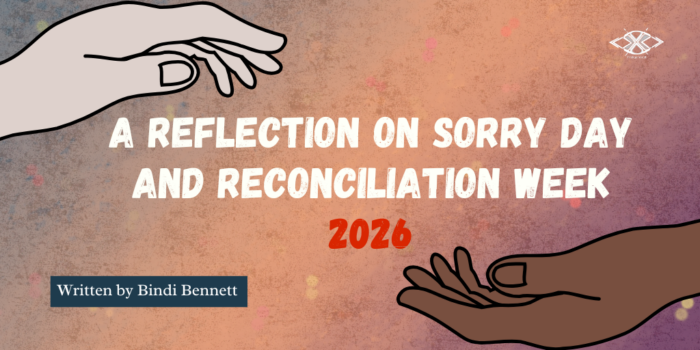
A reflection on Sorry Day and Reconciliation Week 2026
It’s Sorry Day and Reconciliation week
and I’m reminded again that language matters.
White people tell me this constantly.
Use the right language.
Tone it down.
Be careful how you say it.
Be professional.
Be strategic.
Be calm.
Be nice.
Because language matters.
And yet I keep watching white people use language as a weapon against Aboriginal Peoples every single day.
Correcting us.
Explaining us.
Gaslighting us.
Policing us.
Speaking over us.
Hiding behind policy, process, optics and “good intentions” while Aboriginal Peoples drown under colonial and cultural load.
Watching white people collect awards, promotions, praise and recognition for “anti-racism”, “equity” and “reconciliation” while Aboriginal staff are exhausted, isolated, broken and leaving institutions in pieces.
Language matters, Bindi.
But apparently Aboriginal wellbeing does not.
Apparently our pain is inconvenient if it disrupts white comfort.
Apparently racism only counts when it is obvious, historical, far away or performed by “bad people”.
Not when it is structural.
Not when it is institutional.
Not when it is hidden inside governance, complaints, exclusion, silencing, over-explaining, reputation management and defensiveness.
And now comes the gaslighting.
Why aren’t you smiling?
Why aren’t you grateful?
Why aren’t you more collaborative?
Why are you “angry”?
Why are you making this difficult?
Because I am watching people explain why the harm they are causing is not actually harm.
I am watching people intellectualise racism while Aboriginal Peoples continue to die under it.
Carefully crafted statements.
Beautiful acknowledgements.
Perfect reconciliation branding.
LinkedIn posts about justice and allyship.
Endless discussions about wording and tone while our communities are still carrying the statistics, the grief, the removals, the suicides, the burnout, the surveillance, the racism and the premature death.
We are still dying.
And somehow the priority remains protecting white reputations rather than Aboriginal lives.
So yes. Language matters.
But if your language is only ever used to defend power, minimise harm, protect institutions and silence Aboriginal pain, then it is not reconciliation.
In Reconciliation Week the flags are flying. The morning teas are happening. Organisations are sharing carefully designed graphics about unity, respect and walking together. LinkedIn fills with acknowledgements, commitments and reflections on how far Australia has come.
And every year I find myself asking the same question.
What exactly are we reconciling?
Because reconciliation sounds wonderful in theory. It sounds hopeful. Generous. Forward-looking.
But reconciliation cannot simply mean Aboriginal Peoples becoming reconciled to the ongoing realities of colonisation.
It cannot mean becoming reconciled to racism and inequity.
Reconciled to the overrepresentation of our children in care, our people in prisons, our communities in poverty statistics and our families in grief.
It cannot mean becoming reconciled to systems that continue to extract from Aboriginal people while congratulating themselves for inclusion.
Yet sometimes that is exactly what reconciliation feels like.
For many Aboriginal Peoples, reconciliation has become a season rather than a transformation. A week of statements rather than a year of action. A public performance where institutions enthusiastically celebrate relationships while avoiding conversations about power.
Because power remains the uncomfortable part of reconciliation.
Everyone likes the idea of “partnership”.
Far fewer people are comfortable with sharing decision-making.
Everyone likes “inclusion”.
Far fewer people are comfortable when inclusion means changing systems, redistributing resources or challenging existing privilege.
Everyone likes hearing Aboriginal voices.
Until those voices become critical.
Until they name racism.
Until they challenge institutions.
Until they point out that despite decades of reconciliation efforts, Aboriginal Peoples are still carrying disproportionate cultural load, emotional labour and responsibility for fixing systems we did not create.
Then suddenly the conversation changes.
The focus shifts.
The issue is no longer the racism.
The issue becomes the way we describe the racism .
The issue is no longer the harm.
The issue becomes our tone.
The issue is no longer accountability.
The issue becomes reputation.
Aboriginal Peoples learn these lessons very early.
We are often welcomed into conversations provided we remain agreeable.
We are encouraged to share our experiences provided those experiences do not make anyone too uncomfortable.
We are invited to tell the truth provided it is delivered gently enough to protect the people who benefit from not hearing it.
And when we refuse?
When we speak plainly?
When we name what is happening?
We are frequently described as divisive, emotional, difficult or angry.
The irony is remarkable.
Aboriginal Peoples are asked to reconcile with histories and systems that have caused profound harm, while institutions often struggle to reconcile with criticism.
That is not reconciliation.
That is management.
Real reconciliation was never supposed to be comfortable.
Truth-telling is not comfortable.
Learning that institutions you care about have caused harm is not comfortable.
Recognising your own privilege is not comfortable.
Acknowledging that good intentions can coexist with racism is not comfortable.
Yet somehow reconciliation has increasingly been reframed as a process designed to maintain comfort rather than challenge injustice.
Perhaps that is why so many Aboriginal Peoples experience a complicated relationship with Reconciliation Week.
We understand its importance.
We understand the significance of conversations, education and awareness.
We know relationships matter.
But we also know awareness alone does not create change.
Aboriginal Peoples do not need more people to know we exist.
Australia already knows we exist.
The challenge has never been awareness.
The challenge has always been action.
What would reconciliation look like if we took it seriously?
It would look like Aboriginal Peoples being believed when we describe racism.
It would look like institutions addressing cultural load instead of simply celebrating cultural expertise.
It would look like accountability that extends beyond statements and symbolism.
It would look like funding decisions, governance structures and leadership pathways that reflect self-determination rather than consultation.
It would look like non-Indigenous people carrying more of the work that reconciliation currently asks Aboriginal Peoples to do.
It would look like truth-telling that is ongoing rather than annual.
Most importantly, it would involve a shift from asking Aboriginal Peoples to prove harm toward asking institutions how they intend to prevent it.
Because too often reconciliation has been positioned as something Aboriginal Peoples must participate in rather than something Australia must actively pursue.
The burden remains uneven.
The labour remains uneven.
The consequences certainly remain uneven.
As Aboriginal Peoples, we continue to show extraordinary generosity.
We continue to teach.
To explain.
To advocate.
To mentor.
To build relationships.
To create pathways.
To participate in processes that frequently ask us to revisit painful histories while simultaneously reassuring others that they are doing their best.
That generosity should never be mistaken for an absence of frustration.
Nor should resilience be mistaken for acceptance.
The fact that Aboriginal Peoples continue showing up does not mean the work is done.
It means the work remains necessary.
So this Reconciliation Week, perhaps the question is not whether we support reconciliation.
Perhaps the question is whether we are willing to confront what genuine reconciliation actually requires.
Because reconciliation is not measured by how many acknowledgements we deliver, how many events we attend or how many social media posts we share.
It is measured by what happens when Aboriginal Peoples tell difficult truths.
It is measured by how institutions respond when confronted with racism rather than celebrated for good intentions.
It is measured by whether power shifts.
Whether accountability exists.
Whether justice follows.
Until then, reconciliation risks becoming another beautiful word used to describe a future that never quite arrives.
And Aboriginal Peoples have waited long enough.