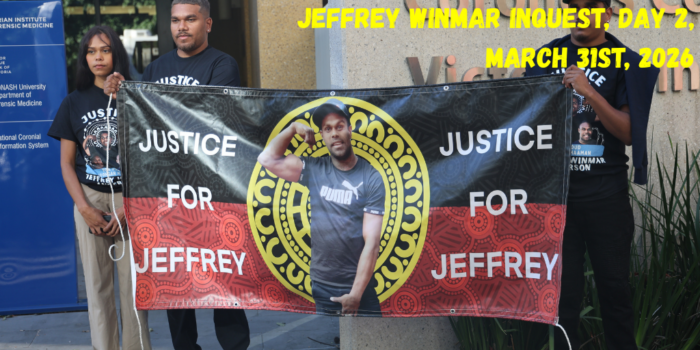
The inquest into the death in custody of Noongar man Jeffrey Winmar commenced on 30th March, 2026, and will continue until 10th April, 2026. These daily reports from Dhadjowa aim to ensure that the community can be truthfully informed of what takes place inside institutional walls.
Disclaimer: Aboriginal and Torres Strait Islander readers please be advised this article mentions the name of an Aboriginal person who has died in custody. This article also mentions acts of violence. Accounts and names have been published with permission given to the author from the family.
Day 2 – 31st March
Two VicPol officers who started the search for Jeffrey on November 9th are called to give evidence today. First Constable Thomas Danyi and Senior Constable Zachary Johnston-Bailey both object to giving evidence on the basis of self-incrimination. Prior to commencing their evidence, the Coroner grants them both certificates to protect them against self-incrimination.
Counsel Assisting invites Danyi to read over his signed seven page statement from November 9th 2023. We hear that additional resources were arranged for the arrest, including extra officers, the Victoria Police canine unit, and a drone unit.
Danyi states that when he first sighted Jeffrey, he was in a tree and appeared to be moving in “slow motion”. Danyi explains he then began giving verbal commands, to come down from the tree, show his hands, and lay down on his stomach.
We hear that when Danyi reached Jeffrey, he was not conscious, and Danyi’s statement reads that he moved Jeffrey to the recovery position, after which he regained consciousness. Danyi’s statement reads that he and the other officer then rolled Jeffrey back onto his stomach, where he was handcuffed, while Jeffrey was “sort of mumbling”.
However, we hear that the body worn camera shows Jeffrey remaining on his stomach and first handcuffed by the officers, not placed into the recovery position.
Counsel Assisting: … would you normally handcuff a person that was unconscious?
Danyi: Ah depending on the circumstances, Your Honour, but not normally if they’re unconscious.
Counsel Assisting: So are you giving evidence that by the time you handcuffed him that Jeffrey had regained consciousness?
Danyi: Ah I, I’d recognised, or I was of the belief that he’d regained consciousness.
It is put to Danyi that the body worn camera shows that Jeffrey was unconscious for longer than 10 seconds, and that he was likely unconscious when he first hit the ground. Danyi agrees with this proposition.
Counsel Assisting puts to Danyi that as the officer who took Jeffrey into custody, he was required to assess him against a VicPol medical checklist. Danyi gives evidence that he was not aware of this medical checklist and that he did not assess Jeffrey against it.
Danyi is asked about the transmission he made over the radio:
“Confirming no injuries to members, ambulance purely as a precaution, the male did pass out upon arrest but he’s back now he’s breathing, I think he’s just a bit rattled and a bit tired, we’ve got plenty of units here and no injuries to members, one in custody”.
We hear that according to the drone footage, Jeffrey was moved and walked 15-20 metres after being handcuffed. Counsel notes that in the footage, Danyi is physically holding onto Jeffrey, who stumbles and gets back to his feet. However, Dayni gives evidence that he does not recall seeing Jeffrey stumble.
Counsel Assisting:..I would even go so far as to suggest not only does he appear to stumble, but he appears to go down onto his knees?
Danyi: Oh I, I don’t recall enough to comment on that, Your Honour.
When examined by Ms Wong, Counsel Acting for Jeffrey’s mum, Ursulla Winmar, Danyi is asked about the use of body worn cameras in planning the arrest:
Ms Wong: It wasn’t considered or talked about in any way?
Danyi: It wasn’t talked about, Your Honour.
Ms Wong:And in those discussions, was there any mention about how Jeffrey’s experience as an Aboriginal person might shape his responses to police?
Danyi: No, Your Honour.
Ms Wong:There was no discussion about how an Aboriginal person, in particular, might experience being chased or pursued by police?
Danyi: Ah no, Your Honour, there was discussion about how we were of the belief that it was extremely likely that Jeffrey would flee on foot, but not specifically that, Your Honour.
In the afternoon while giving his evidence, Senior Constable Johnston-Bailey is asked a series of questions about his observations and involvement in Jeffrey’s arrest.
Counsel Assisting:You describe that there were multiple people yelling at him, ‘Police, get off the roof’. Were you one of those people?
Johnston-Bailey:I don’t recall, but likely yes.
Counsel Assisting:What did you see Jeffrey do?
Johnston-Bailey: Basically took a couple of sort of running steps and launched off the back of the house um towards the rear fence.
Counsel Assisting:Did you give any consideration to for example just calling the arrest off and letting him go?
Johnston-Bailey: No.
Counsel Assisting: On one view, Jeffrey’s going to extreme lengths running away along the top of a building and then taking a flying leap, as you recall seeing, that’s conduct that places him at risk. Is it relevant for you to consider whether you should pull back because police presence is making him take such extreme risks, for his own safety? Would that be a reason to pull back?
Johnston-Bailey:I don’t believe so.
During Johnston-Bailey’s evidence, we learn that he was the officer who handcuffed Jeffrey after he fell down from the tree. It is put to Johnston-Bailey that Jeffrey appears to collapse in a way that indicates he was unconscious at the time.
Johnston-Bailey: It could be, I don’t know if he, if he went unconscious or not.
Counsel Assisting:As you moved in, having seen him go to the ground in that way, did you think he was unconscious?
Johnston-Bailey: In all honesty I didn’t know, but I guess, like it’s a possibility. Um it’s not, it wasn’t sort of clear cut in terms of why he’d done that at the time, um but there’s every chance I guess like, yeah, I for sure considered at the time there’s every chance he could be unconscious.
Counsel Assisting:Do you agree that using handcuffs is a use of force?
Johnston-Bailey:Yep.
Counsel Assisting: As best you can recall, the way his arm felt when you moved it for the purposes of handcuffs, was it the arm of someone who was conscious or unconscious?
Johnston-Bailey:I wouldn’t, I guess I probably haven’t had the experience to, to tell you, answer that.
The inquest into the death in custody of Noongar man Jeffrey Winmar will run from 30 March until 10 April. Johnson-Bailey will be called to continue his evidence tomorrow morning.
Please join us in supporting his family by attending the Victorian Coroner’s Court at 10am each day.
This article was compiled for the Dhadjowa Foundation by Natalie Ironfield.
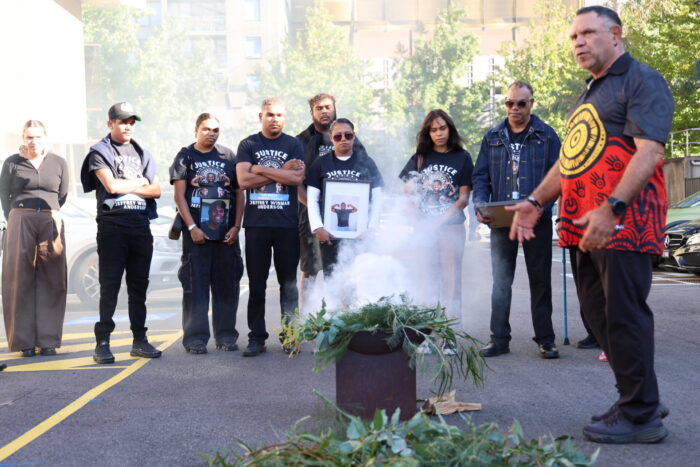
Smoking Ceremony outside the Coroner’s Court of Victoria. Images supplied by the Victorian Aboriginal Legal Service.
Readers please be advised that this article mentions a person who has passed away. 3August 2026 “Felipe’s life mattered. His death mattered. What we learn…
This Aboriginal and Torres Strait Islander Children’s Day, we have an opportunity to reflect on something remarkable. Across Victoria, our Aboriginal and Torres Strait Islander…
A reflection on Sorry Day and Reconciliation Week 2026
It’s Sorry Day and Reconciliation week and I’m reminded again that language matters. White people tell me this constantly. Use the right language. Tone it…
Subscribe
I would like to receive the IndigenousX monthly newsletter