There is an increasing popular myth that australia Day is on the 26th of January because it commemorates the 1948 Citizenship Act. So what is the point of this obvious lie?
Disclaimer: First Nations readers please be advised that this article mentions acts of racism and features antiquated language.
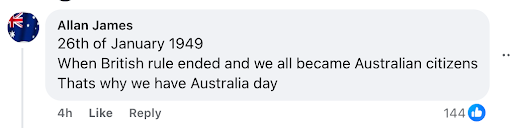
If, like me, you were foolish enough to spend any time in the comments section of the seemingly infinite barrage of racist posts and articles circulating on social media yesterday, you probably saw a post that claimed that Australia Day actually has nothing to do with 1788, but instead it’s all about 1949, “when British rule ended and we all became Australian citizens”.
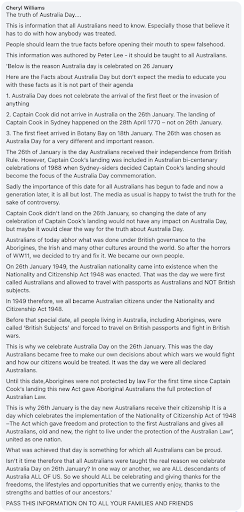
There was a super long version, complete with several dot points, that I have included a screenshot of at the end of the article for reference, but this version gets the key point across.
Now, credit where credit is due, this seems like a super clever way to take the first 161 years of atrocities committed against Aboriginal people (which are pretty hard to defend) out of the conversation.
It lets people who want to celebrate Australia Day no longer have to confront the realities of invasion, dispossession, frontier violence and the more than 10,000 Aboriginal people killed in over 400 massacres which occurred across Australia between 1788 and 1928. And, before someone asks, “it is estimated that 168 non-Aboriginal people were killed in 13 frontier massacres”.
As was said in the longer version of the post ‘Australians of today abhor what was done under British governance to the Aborigines’, and now, thanks to this super clever argument, we no longer have to contend with any of it. How convenient! Not only that, it means that anyone trying to bring up anything pre-1949 is technically incorrect because none of that stuff has anything to do with Australia Day anyway.
Of course, we have to ignore the fact that the 26th of January 1788 has been commemorated since at least 1808, albeit under different names (Anniversary Day, Foundation Day etc). Not to mention that every state and territory adopted the name Australia Day by 1935 and had a public holiday for it on or around that date by 1940.
We also, luckily, get to ignore that for the 1938 Australia Day Sesquecentenary a group of 25 Aboriginal men from Menindee were taken from their homes, held in Redfern Barracks, and forced to participate in a re-enactment of the landing of the First Fleet. The men were told that if they didn’t participate, their families would starve.
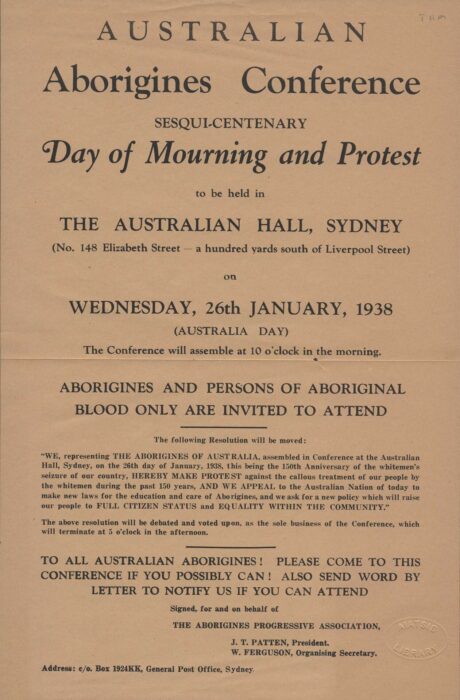
And since we’re ignoring 1938, we can go ahead and ignore the first Day of Mourning (which specifically referenced the 26th of January as Australia Day).
‘Aborigines claim citizen rights!: A statement of a case for the Aborigines Progressive Association.’ Credit: AIATSIS
Instead, we can all celebrate the 26th January 1949, when the “Australian nationality came into existence” with the enactment of the Nationality and Citizenship Act 1948. “This was the day Australians became free to make our own decisions about which wars we would fight and how our citizens would be treated”.
And since I enjoy discussing history as much as the next person, let’s pretend like all of that is true, and that’s what Australia Day is really about.
It kinda begs the question though, how were Aboriginal citizens treated in 1949?
I’m glad you asked.
Although Aboriginal people were technically made citizens of Australia in 1949, they were not granted citizenship rights and, not to be a stickler, but having citizenship without citizenship rights is a fairly important consideration.
As this was pre-1967 referendum, each state and territory had their own specific Acts and laws which brought this into effect, but in essence, Aboriginal people were invariably deemed ‘wards’, which enabled state and territory governments to retain control over every aspect of the lives of Aboriginal people. This included where people could live, work, who they could marry, and whether or not they would have their children removed from their care.
Aboriginal people could apply to get citizenship rights but, as it says on the WA Museum website:
“Aboriginal people still had to apply for citizenship and meet certain criteria. Meeting this criteria meant removing themselves from their community and culture. This Act was not repealed until 1971.”
For those who were granted these rights, they were then technically* allowed to vote, buy alcohol, have freedom of movement, own property etc but it was a requirement that they would then not associate with Aboriginal people, couldn’t give alcohol to other Aboriginal people (look up the story of Albert Namatjira for more on this!).
A useful anecdote is a story of when Oodgeroo Noonaccul met then Prime Minister (and big fan of Hitler, defender of Apartheid in South Africa, and champion of the White Australia Policy), Robert Menzies, in Canberra in 1963. Apparently Menzies offered a glass of wine during their meeting and she noted that, if he had done that in Queensland, he could be sent to prison.
And even if an Aboriginal person was made exempt from the openly racist and discriminatory laws of the day, they were still commonly discriminated against in all walks of life because of course they were – racism doesn’t disappear just because you got yourself a bit of paper!
*can I just say, the word ‘technically’ is getting one hell of a work out in this article.
The path to citizenship and to ‘inclusion’ for Aboriginal people remains then the same as it does now. It is a conditional inclusion and acceptance reliant entirely on the idea of complete assimilation that can be withdrawn the moment an Aboriginal person falls out of favour or says something that doesn’t meet the inconsistent expectations of what it means to be ‘Australian’.
Still though, like I said, super clever argument, great effort, complete bullshit of course, but still, well done you! I think we can all agree that there is no greater tribute to Australia or to the spirit of Australia Day than wilfully lying about our history in order to dismiss atrocities committed against Aboriginal people.
Maybe for next year we can pretend that the 26th of January doesn’t have anything to do with 1788 or 1949 and it’s actually just a commemoration of the 1988 Bicentennial so we can’t include any discussion of anything that happened before 1988 when we talk about Australia Day… Of course, we would have to ignore what the Bicentennial was bicentennialling, and even then some cheeky bugger would just bring up Aboriginal Deaths in Custody (ongoing), endless child removal (ongoing), the NT Intervention, locking up 10 year olds (ongoing), the failed Referendum and all the racist vitriol it has unleashed (ongoing), or even just the ever present (but slightly more obvious in the last few years) links between Australian patriotism and White supremacy. Or that there was an attempted terror attack at an Invasion Day rally in Perth this year!
Or maybe we can scrap just Australia Day altogether and then we can celebrate the 26th of January starting from 2027, as the day we finally got rid of this racist piece of shit holiday.
Some Books You Can Read Instead Of Celebrating ‘Australia Day’
We are still here, we have survived. I am a bookworm at heart, and keep track of all the books I read, I know when I was at an Invasion Day march on Gadigal Country two years ago, I was reading Dark Emu by Bruce Pascoe at the time. Carrying it around in my backpack, next to my water bottle and my phone, switched off. Why would I need my phone when everything I need to feel connected to my people is right here?