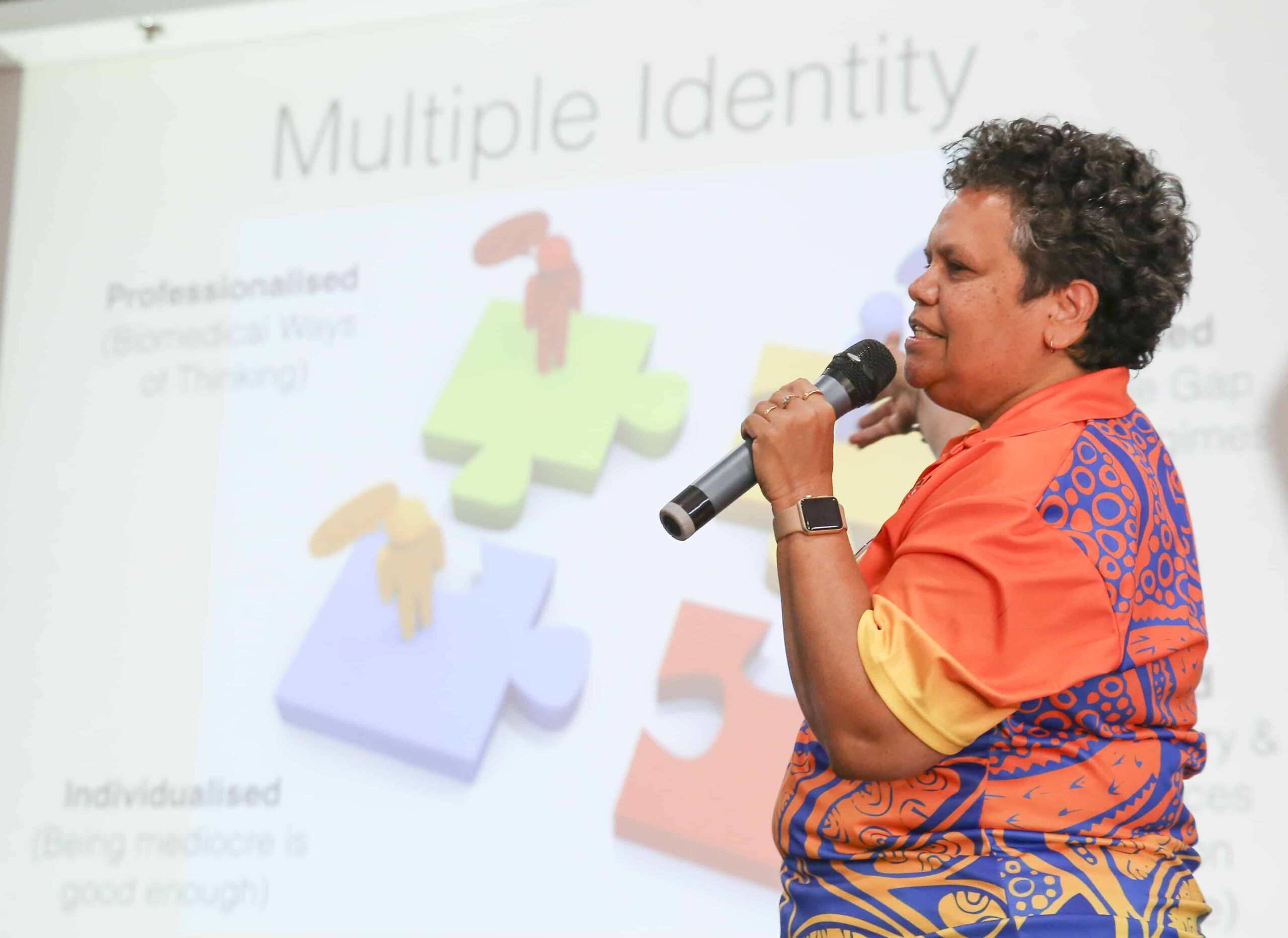
Kristine Garrett is an Aboriginal woman from Central Queensland with ancestral ties to the Wulli Wulli and the Darumbal people of the region.
For most of my career I have travelled up and down the east coast of Australia doing different jobs. At the age of 27 I was living and working on the Block in Redfern. I was there when the Eora Centre (back then it was the Visual and Performing College) was just being built. They were radical times – one Radio Redfern Tagline ‘The Station that make your Black Hearts Burn’. Nostalgic I know but, them were the days.
In 2013 I was fortunate to be offered the CEO Position at Galambila in Coffs Harbour New South Wales. As someone from off-country, and a Murrie to boot, you have to work hard on community and kinship protocols.
No matter what age you have to walk the culture path, be humble, pay respect to elders, ask where you can or cannot go and ask what community want to see at their organisation. Sometimes it is something very simple like offering a cup of tea.
Building rapport is sometimes based on unwritten codes – we are still oral people and so much is dependant on what we say and do; or we do what we say. Some family groups already knew me from the Redfern days or had ways of finding out about me. So my transition was slow and I really wanted to gain an insight into the community and the organisation.
No matter where I worked, there were cultural clashes that caused division in workplaces especially in Aboriginal Affairs because of the risk factor politically and socially. Sometimes subtle organisational norms, other times quite blatant practices bordering on racism, and sometimes we as Aboriginal people are too accepting of the racial overtones.
My observations at Galambila that initially bio-medical constructs dominated the culture of our organisation and it caused tension across into other areas. Our Aboriginal workforce are from the community so they faced the same social disadvantage, sometimes they are the only income of the extended family, at times they cannot pay bills, they face violence and as a CEO I too carry a cultural load.
No matter where I worked, there were cultural clashes that caused division in workplaces especially in Aboriginal Affairs because of the risk factor politically and socially.
What occurs when tensions are driven from multiple identities; bio-medical, political, social and individualised, it becomes unclear what we stand for as an organisation.
We face those tensions today especially relating to Traditional Medicine. Even today I continue with my debate about traditional medicine; we can place a bowl of Apples on the reception table and say ‘this is good for you’ and yet we can’t say the same for Wattle Tree Tea, Sarsprilla Vine or even my go to herb native Gumbi Gumbi.
Is it that they haven’t been studied? Or is it because they haven’t been grafted and commercialised? I am yet to find the answer so I continue to stimulate the conversation.
The World Health Organisation has established guidelines for alternative approaches, acupuncture etc and we are sometimes too slow to capitalise on our opportunities. It becomes a resourcing issue always doing the urgent rather than the important things.
Major changes were introduced in 2014 at Galambila. The Aboriginal Workforce moved to front-line services, it didn’t matter whether the workers were drivers, facility maintenance workers, receptionist, admin, doctors, nurses, Aboriginal Health Workers, Board members, community members or other key stakeholders everybody could have a say.
The challenge was we were no closer to knowing what we stood for as an organisation. We needed a framework to bind all the differencing of opinions to identify our true essence of what we say and do.
Through a quality framework ‘Yiidagay Darundaygu’ (Gumbaynggir Language ‘Always becoming good for a Purpose’). The Cultural Integrity was formed and we are still working on it today.
Giinagay is hello in Gumbaynggir Language – our Board were the real drivers to the introduction of Gumbaynggir Language across the organisation as it provides a connection, automatically when you engage with Galambila you are part of something wonderful.
Galambila’s Image is paramount we are no longer known as Gamin-billa, our business is to care and sometimes that is as simple as a smile when you walk into the Clinic, offering a cup of tea. Laughter is the sweet sound of success not forgetting Galambila is also a place where we can cry. Giinagay is hello in Gumbaynggir Language – our Board were the real drivers to the introduction of Gumbaynggir Language across the organisation as it provides a connection, automatically when you engage with Galambila you are part of something wonderful.
What has been an unexpected benefit to our approach, has been Galambila serving an active Aboriginal Clients demographic representing 87% of the Aboriginal population on the Coffs Coast. Our medicare income has tripled over 4 years. To lead collectively is a willingness to dream for the same things. With a stable Board of Directors, fantastic management, solid staff and loyalty to our community anything is possible – but be warned it is a lot of hard bloody work.
—————————————
Kristine was a keynote speaker for the NATSIHWA Professional Development Symposium 2018, ‘Engaging our Workforce’, the focus is on upskilling Aboriginal and/or Torres Strait Islander Health Workers and Health Practitioners through a series of interactive workshops. The event is being held in Alice Springs.
Readers please be advised that this article mentions a person who has passed away. 3August 2026 “Felipe’s life mattered. His death mattered. What we learn…
This Aboriginal and Torres Strait Islander Children’s Day, we have an opportunity to reflect on something remarkable. Across Victoria, our Aboriginal and Torres Strait Islander…
A reflection on Sorry Day and Reconciliation Week 2026
It’s Sorry Day and Reconciliation week and I’m reminded again that language matters. White people tell me this constantly. Use the right language. Tone it…
Subscribe
I would like to receive the IndigenousX monthly newsletter