Aboriginal Stories of Country welcome all visitors, ask people to listen and learn from them, to respect their country and in particular respect their sacred sites
Since Christmas last year I have been travelling with my partner and our four children through various Australian states and territories.
During that time, we have had amazing experiences and wonderful educational experiences.
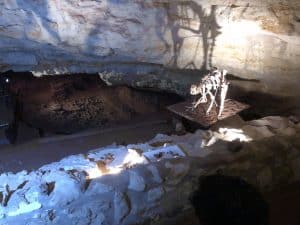
Naracoote caves
We have been to the caves of Naracoote and witnessed first-hand the digging pits where ancient bones are being revealed.
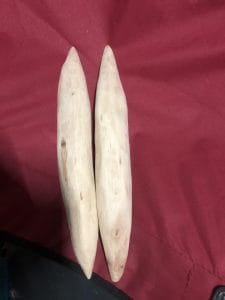
We participated in the Dupang Festival on Ngarindjerri Country (Coorong) where our children worked together to carve clap sticks from coastal she oak and learned how to weave with the Aunties.
Clapsticks made from she oak
We explored Wilpena Pound and listened to the stories from the Adnyamathanha people about how the country was formed and how these stories are connected to knowledge of the location of coal and uranium deposits.
For the last 11 months our family has been living on the interface between Australia’s national story and the stories of Country from Aboriginal people.
The national story still speaks of the great discovery, the great explorers and praising the early settler’s bravery and ingenuity for surviving and taming a harsh environment.
At best the Australian story acknowledges a previous occupation of Aboriginal people and may even acknowledge the name of the clan groups and display some artefacts; a relic of the past.
In contrast, the Aboriginal Stories of Country welcome all visitors, ask people to listen and learn from them, to respect their country and in particular respect their sacred sites. It is a story of the world’s oldest continuing culture, and of knowledge that has been developed for over 60,000 years.
Unfortunately, these stories are usually summarised on sign posts, with the exception of a few places where Aboriginal tourism is thriving.
The obvious tensions between these two stories manifest themselves in the behaviour and conversations of tourists. It got to the point where I would just stop talking to people because I was sick of hearing racism that directly targeted Aboriginal people; “nice place but too many Abos” or “you got to keep the Abos out” was the general gist of the comments.
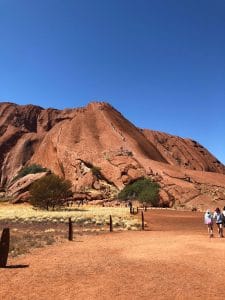
Before travelling I knew that I would be confronted with racism and, in particular, confronted with Australians disrespecting the wishes of traditional owners; like Australians’ need to climb Uluru even though in 1985 the Anangu people requested that people respect their sacred site and refrain from climbing. In 2018, they still climb Uluru and this level of total disregard and disrespect affected me deeply.
In 1985 the Anangu people requested that people respect their sacred site and not climb it.
Aboriginal Stories of Country welcome all visitors, ask people to listen and learn from them, to respect their country and in particular respect their sacred sites.
However, I found it even more confronting when I was at Karlu Karlu (Devil Marbles) a sacred site for the Warumungu, Kaytetye, Alyawarra and Walpiri people.
The tourists again ignored the signs and climbed on top of boulders on the sacred part of Karlu Karlu with beer in hand and mooning their mates; ignoring the tracks that led to a view point, with the same view, that was not part of the sacred area.
Unfortunately, this was not the most confronting experience. The most confronting was when a tour bus of high school students from Tumut arrived at Karlu Karlu. The students with teachers in tow ignored the signs, fencing and designated tracks to climb Karlu Karlu in the sacred area.
The question that came to my mind immediately was, “What lessons did those students learn today?”. Did they learn that it’s ok to have no respect for Aboriginal people and their sacred sites? Did they learn that you do not have to understand or respect the believes of other cultures? Perhaps they simply did not know? What then of the role of the teachers as educators? What are they teaching the next generation, the future leaders of Australia?
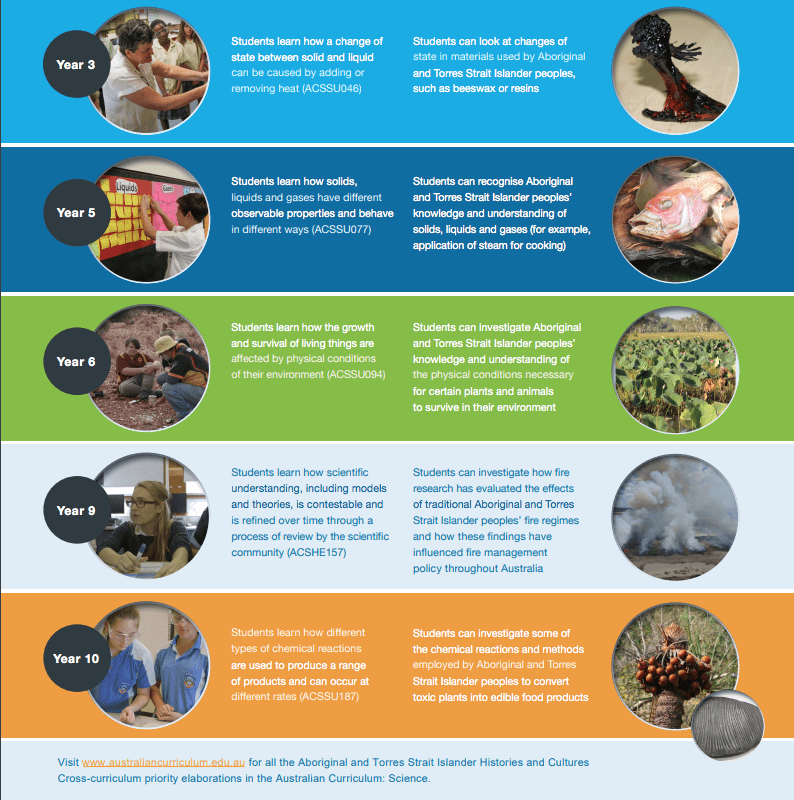
For me, this immediately reinforced the need to have the Aboriginal and Torres Strait Islander Histories and Cultures cross curriculum priority in the Australian Curriculum.
This cross curriculum priority allows for Aboriginal and Torres Strait Islander perspectives to be taught across all learning areas, including science and mathematics, as part of the national curriculum.
The curriculum for all learning areas has already been set, and all states and territories have been using this curriculum, in a variety of ways, since 2014. The Curriculum includes mandatory content descriptions that sets out which content needs to be taught at different stages and in different areas of learning.
Subsumed by the content descriptions are elaborations which are suggestions to teachers (i.e. not compulsory) of different ways to teach each content description. Aboriginal and Torres Strait Islander Histories and Cultures cross curriculum priority, like the other two cross curriculum priorities, set out a series of elaborations for teachers that will enable them to include Aboriginal and Torres Strait Islander perspectives while teaching the prescribed content (if they choose to do so).
As a professional who has worked and will continue to work with Australian Curriculum and Reporting Authority (ACARA), the hope is that most teachers will take on the challenge and teach more about Aboriginal and Torres Strait Islander Histories and Cultures for all students.
At the moment, we are all living in the wake of Terra Nullius, the doctrine that Australia was colonised under, which has created a huge rift between Aboriginal and Torres Strait Islander peoples and other Australians.
Terra Nullius denied the existence of Aboriginal and Torres Strait Islander peoples relegating us as the most primitive people on the planet, that is, our culture had no relevance to the new “modern” society that came to these shores.
But Terra Nullius also had the effect that many non-Indigenous people in Australia never had the opportunity to have any really understanding of Aboriginal and Torres Strait Islander peoples and their cultures.
This relationship gap is a scar on the psyche of Australia, and its ramifications are poorly understood and continue to hold us back as a nation.
Aboriginal and Torres Strait Islander cultures are relevant, and are sophisticated and applicable to a “modern” Science curriculum
The Aboriginal and Torres Strait Islander Histories and Cultures cross curriculum priority in the Australian Curriculum has the potential to change this by providing teachers and students with a better understanding of our cultures and histories.
In November this year, over 90 elaborations were released for the Science curriculum that can be used to teach essential content in the Science curriculum. This sends a clear message that Aboriginal and Torres Strait Islander cultures are relevant, and are sophisticated and applicable to a “modern” Science curriculum including areas such as chemistry and physics.
As further support to teachers, there are complimentary projects that are creating detailed resources for teachers to include Aboriginal and Torres Strait Islander perspectives for elaborations across all learning areas.
The Department of the Prime Minister and Cabinet has also recently engaged the University of Melbourne, under the lead of Professor Marcia Langton AM, to strengthen Australian school
students’ knowledge of Aboriginal and Torres Strait Islander histories and cultures across Australia.
Given that I have a PhD in mathematics and extensive work in mathematics education for Aboriginal and Torres Strait Islander learners, I am keen to see this work extend to the mathematics curriculum. I will write more about this in future articles. In the meantime, I would recommend to all readers to check out the new elaborations from ACARA, as well as the work from Professor Langton, which will be based on three themes: astronomy, fire, and water.
One of the 21st century skills purported by education experts is the ability to work and communicate in a cross cultural context.
In Australia, we need to start at home and close the relationship gap that is holding us back as a nation.
We need our future leaders to respect our cultures, value our knowledges and realise its importance for a sustainable future.
We need leaders who can work globally across many cultures to meet global challenges, such as climate change.
I don’t want to live in a nation that is paralysed by the politics of fear, the fear of other people, the fear of other cultures and that justifies the detention of families who are seeking asylum.
This change needs to start with taking the Aboriginal and Torres Strait Islander cross curriculum priority seriously which will pave the way for a better future.
Readers please be advised that this article mentions a person who has passed away. 3August 2026 “Felipe’s life mattered. His death mattered. What we learn…
This Aboriginal and Torres Strait Islander Children’s Day, we have an opportunity to reflect on something remarkable. Across Victoria, our Aboriginal and Torres Strait Islander…
A reflection on Sorry Day and Reconciliation Week 2026
It’s Sorry Day and Reconciliation week and I’m reminded again that language matters. White people tell me this constantly. Use the right language. Tone it…
Subscribe
I would like to receive the IndigenousX monthly newsletter